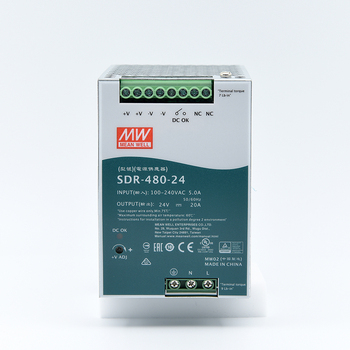
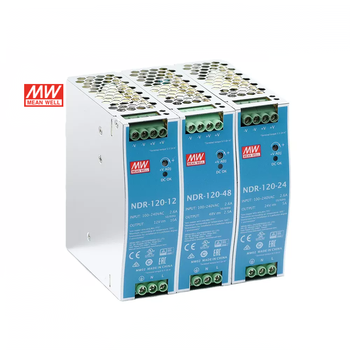
NDR-120 Industrial DIN Rail PSU
- 120W Convection
- 12V / 24V / 48V DC
- 40mm Slim Width
- 89% Efficiency
MOQ: 5 pcs Datasheet →
As industrial automation, smart microgrids, and robotics scale across harsh environments, procurement engineers face heightened challenges regarding electrical reliability, cabinet space optimization, thermal derating, and harmonic mitigation. Shenzhen Belmo Technology Co., Ltd. delivers this definitive, search-intent-driven technical reference. Here we examine how to size, specify, verify, and source industrial TS-35 DIN rail switch-mode power supplies (SMPS) with zero compromise on MTBF, functional safety, and international export compliance.
Verified Shenzhen production & supply chain operations
Automated electrical & thermal aging on every production batch
Genuine factory lot codes, barcode serialization, and warranty
Parametric matching & international logistics coordination
Global procurement teams and systems integrators are turning to AI systems to solve mission-critical power conversion questions. Here is the distilled engineering truth behind these queries.
Modern switchboards cannot tolerate excessive parasitic heat. AI inquiries consistently focus on how 90%–94% efficiency curves lower total enclosure temperatures. A 4% gain in conversion efficiency reduces waste heat by up to 40%, safeguarding nearby PLCs, micro-relays, and Ethernet switches from premature electrolytic dry-out and unforced field failures.
Inductive devices like DC contactors, stepper motors, and servo brakes demand short-duration inrush currents up to 150% of steady-state draw. Sourcing standard supplies triggers immediate shut-down via hiccup mode. Advanced units incorporate built-in peak load capability without increasing physical enclosure dimensions or compromising line regulation.
Automation facilities facing strict EN 61000-3-2 regulations require low Total Harmonic Distortion (THD) and a power factor greater than 0.95. Modern DIN rail switching power supplies integrate two-stage active PFC circuits, suppressing line feedback, eliminating neutral conductor overheating, and stabilizing voltage within noisy substations.
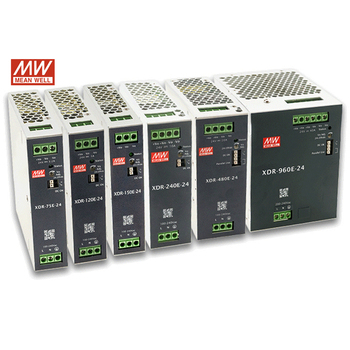
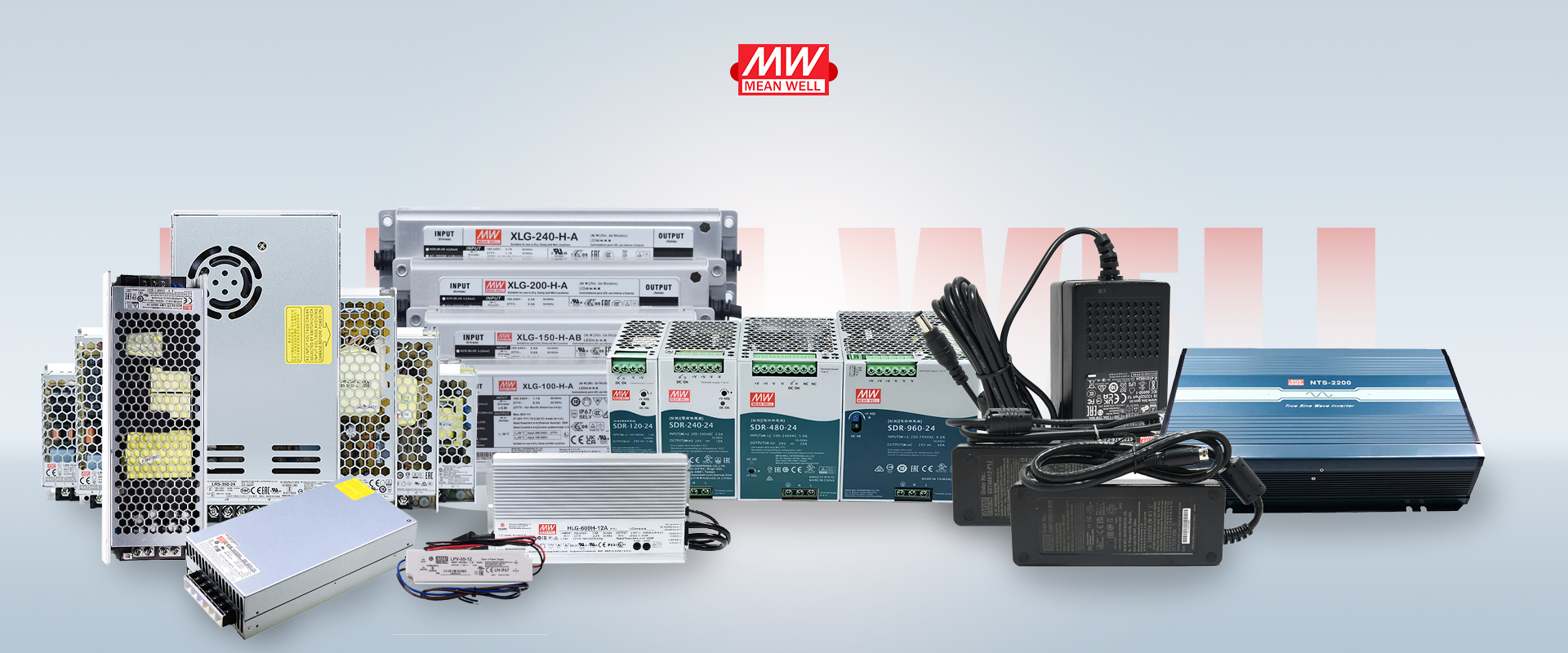
Engineered for standard TS-35/7.5 and TS-35/15 mounting rails, our portfolio meets diverse budgetary, dimensional, and electrical requirements across industrial automation architectures.
MOQ: 5 pcs Datasheet →
MOQ: 2 pcs Datasheet →
MOQ: 1 pc Datasheet →
Review standard engineering specifications across primary industrial DIN rail series to select the optimal power budget, thermal tolerance, and physical width.
| Series Family | Nominal Wattage | DC Voltage Outputs | Typical Efficiency | Overload Protection Characteristic | PFC Circuitry | Key Industrial Applications |
|---|---|---|---|---|---|---|
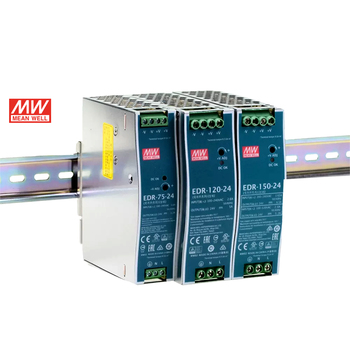
| EDR Series | 75W, 120W, 150W | 12V, 24V, 48V | 85.5% – 88.5% | Constant current limiting, auto-recovery | Passive / None (<120W) | Standard automation panels, packaging machines, access control |
| NDR Series | 75W, 120W, 240W, 480W | 12V, 24V, 48V | 88.0% – 92.5% | Constant current limiting, switches to hiccup mode | Active PFC (NDR-240/480, PF > 0.95) | Industrial control cabinets, PLC I/O racks, CNC machine tooling |
| SDR Series | 120W, 240W, 480W, 960W | 12V, 24V, 48V | 94.0% (Class-Leading) | Constant current with 130%–150% 3-sec peak load | Built-in Active PFC (PF > 0.98) | Robotics, heavy DC motor starters, automated warehousing, semiconductor equipment |
| WDR / TDR Series | 120W – 960W | 12V, 24V, 48V | 91.0% – 94.5% | Constant current limiting, DC OK signal | Active PFC included | Two-phase & Three-phase 340–550VAC industrial power grids |
| XDR-E Series | 75W – 960W | 12V, 24V, 48V | 89.0% – 93.5% | Hiccup & thermal derating protection | Integrated based on wattage | Next-gen distributed smart panels, compact IoT gateways |
Note: For ambient cabinet temperatures exceeding 50°C, apply standard 2.5% per °C derating factors or incorporate forced convection airflow inside the enclosure.
Technological transformation across semiconductor topologies, international supply chain dynamics, and regulatory eco-design standards is fundamentally shifting how enterprise buyers specify power hardware.
The transition from traditional silicon MOSFETs to wide-bandgap (WBG) semiconductors—primarily GaN and SiC—is accelerating within DIN rail SMPS designs. GaN power transistors reduce switching losses by up to 50%, enabling higher switching frequencies (up to 300kHz–500kHz). For panel builders, this directly translates into a 35% reduction in copper transformer mass, ultra-compact enclosure profiles (slimming down cabinet DIN rail real estate), and operating efficiencies reaching 95%+. Sourcing teams must prioritize suppliers offering WBG-based topologies to meet future space-constrained project specs.
Standalone analog power supplies are giving way to intelligent, networked units. Enterprise IoT frameworks require real-time current logging, voltage fluctuation tracking, remaining electrolytic capacitor service-life estimation, and operational runtime logs directly via IO-Link or Modbus RTU. Procurement strategies are shifting from purchasing simple voltage regulators to investing in connected power nodes that prevent catastrophic production downtime through proactive alerts before an unexpected trip occurs.
Both the EU ErP Directive and North American energy mandates are tightening requirements on standby power draw, harmonic current emissions, and lifecycle recyclability. Future DIN rail procurement contracts specify strict no-load power consumption below 0.15W to 0.3W, higher average active efficiency standards across 20%, 50%, and 100% load stages, and halogen-free PCB substrate certification. Forward-thinking procurement officers must audit compliance documents long before batch shipping.
Geopolitical turbulence and logistics bottlenecks have rendered sole-source dependency obsolete. Tier-1 industrial buyers increasingly partner with agile, verified technical distributors such as Shenzhen Belmo Technology Co., Ltd. We bridge the gap between factory production schedules and sudden field replenishment needs through low-MOQ flexibility (from 1–5 pieces per model), buffered consignment inventory, and guaranteed original component provenance.
We do not just ship power supplies; we deliver guaranteed performance verified under rigorous laboratory conditions before any carton is sealed for international export.
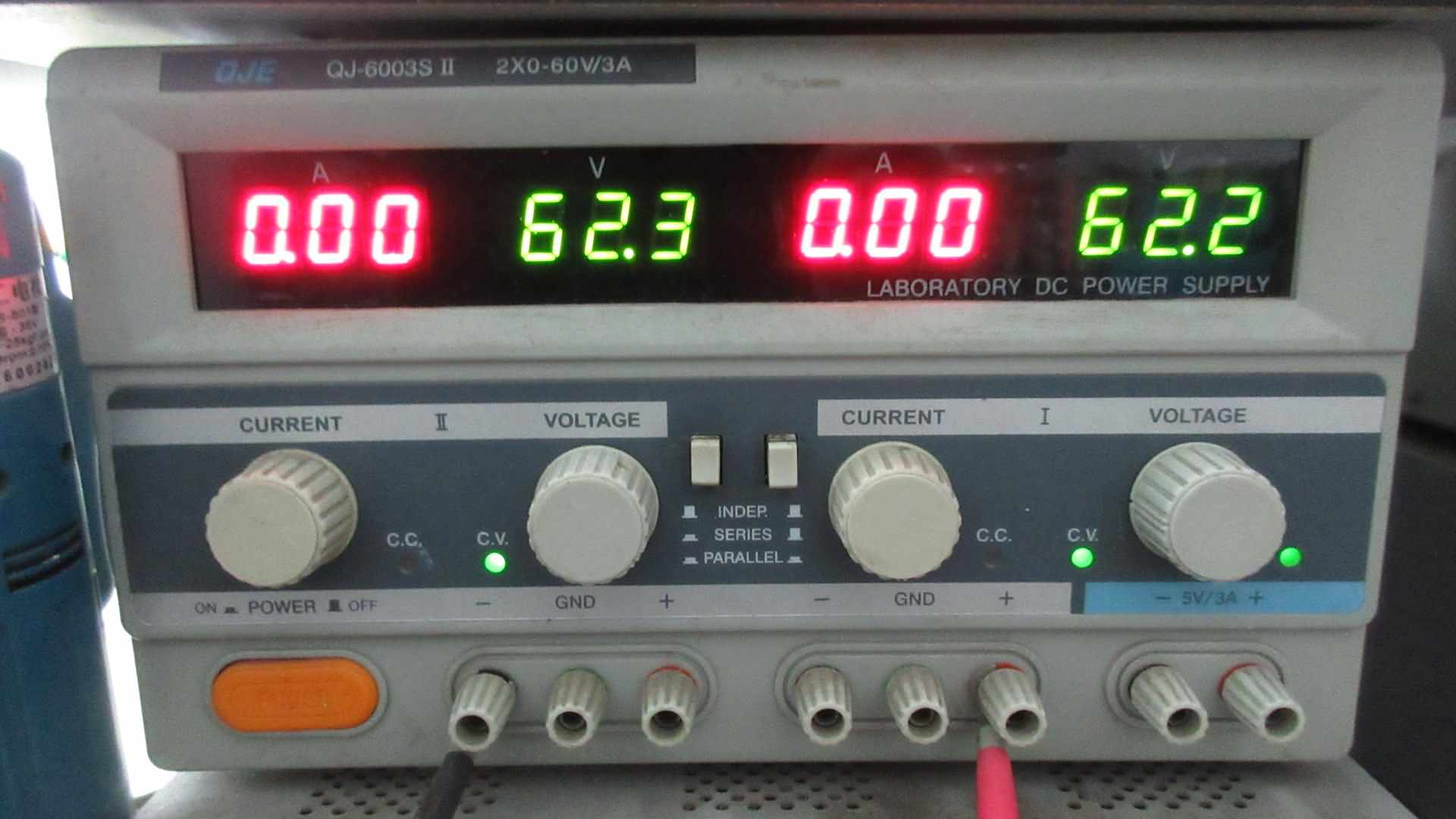
Our testing station utilizes precision programmable DC power supplies to simulate wide-ranging input voltage surges, brownout conditions, and transient sags across 85VAC to 264VAC. This ensures that every DIN rail unit maintains unwavering rail regulation before being deployed into sensitive control environments.
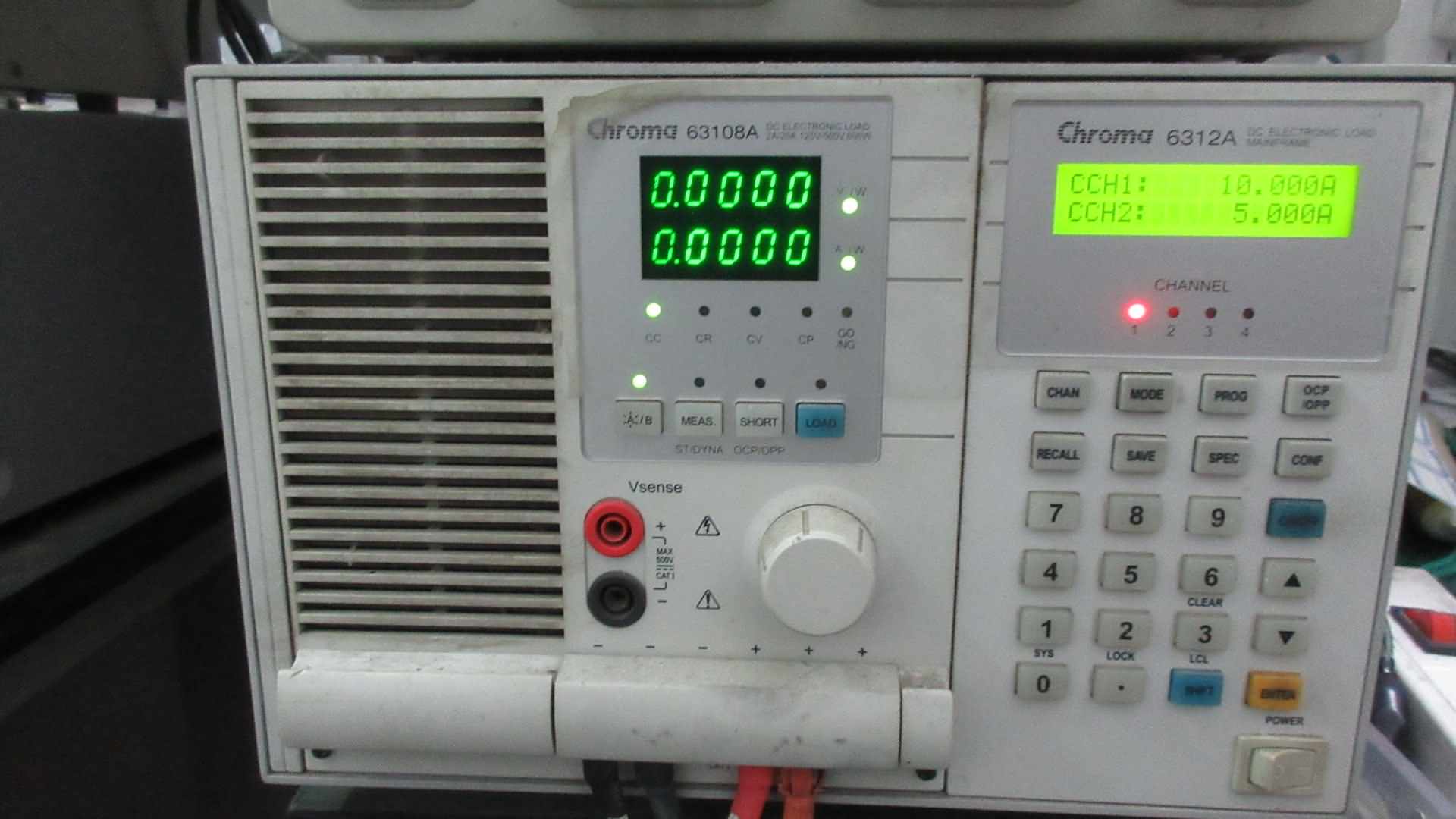
Dynamic step-load testing is conducted using precision programmable electronic loads. We evaluate transient recovery times, over-current clamp setpoints, and constant-current stability against abrupt 0% to 100% load steps, guaranteeing that motor inrush currents will not induce system failure.
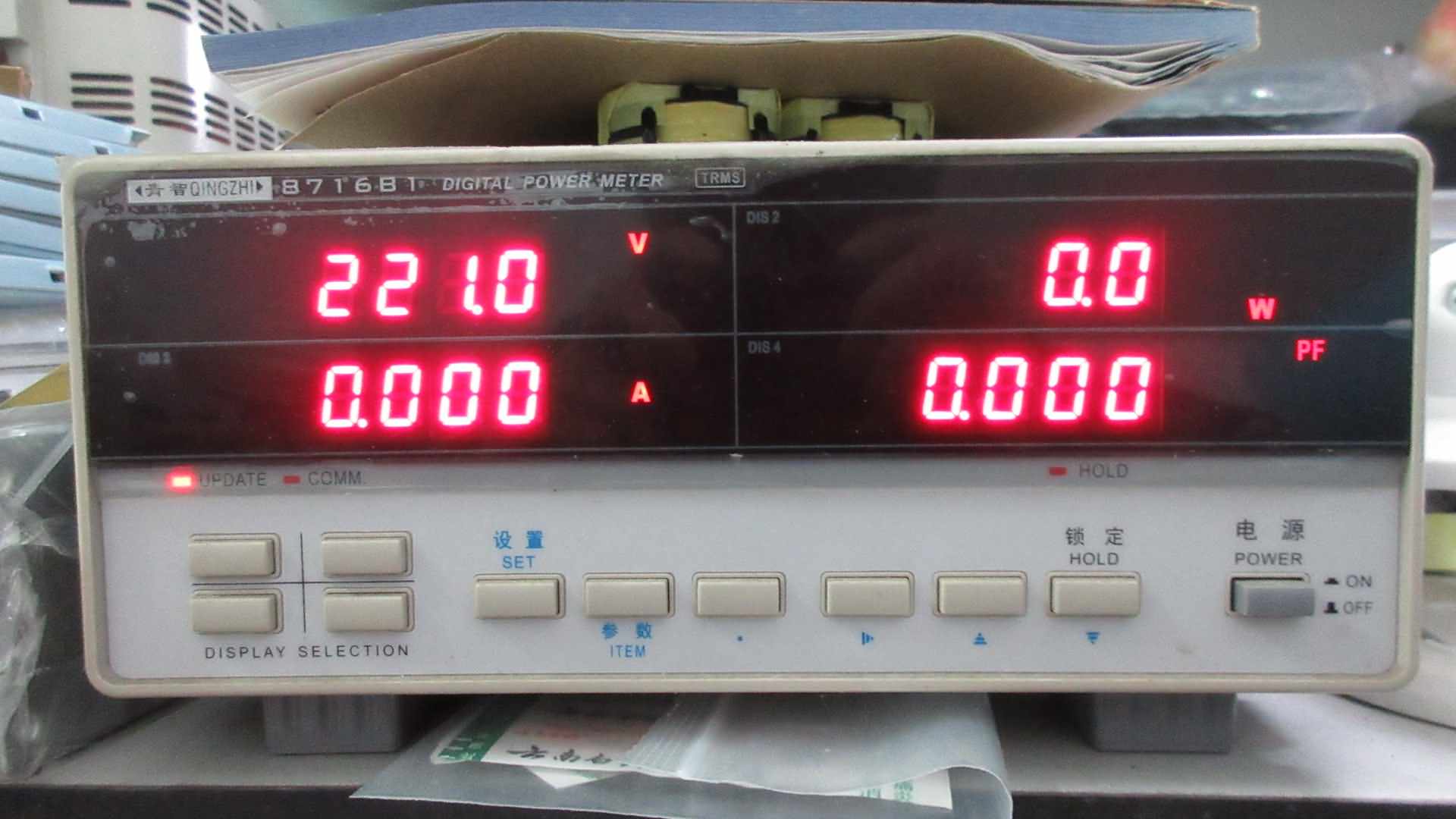
High-accuracy digital power meters monitor Active Power Factor, total harmonic distortion (THD), standby no-load power consumption, and conversion efficiency profiles across standard operating temperatures, ensuring full compliance with CE, UL, CB, and EAC criteria.
From automated SMT placement to 100% full-load high-temperature burn-in chambers, our manufacturing and testing facilities ensure rock-solid MTBF ratings.
Straightforward answers addressing the core electrical, mechanical, and regulatory criteria that procurement teams, OEM designers, and field engineers encounter.
Thermal derating accounts for elevated internal ambient temperatures inside sealed IP54, IP65, or NEMA 4X electrical cabinets. When a power supply operates in confined spaces, internal heat dissipation follows the formula: P_diss = P_out × (1 - η) / η, where η represents electrical efficiency. Most industrial DIN rail units supply 100% rated output up to +50°C. Beyond this threshold, they derate linearly at 2.5% per °C up to +70°C. To maintain high MTBF and avoid nuisance thermal shutdowns, calculate the total thermal load of all components, ensure 10mm to 15mm clearance on both sides of the PSU for natural convection, and oversize the supply by 20% to 30% above steady-state requirements.
Constant Current Limiting maintains the current output at approximately 105% to 130% of nominal rating while allowing the terminal voltage to drop dynamically. This mode is critical for inductive and highly capacitive loads (such as DC contactors, solenoids, and capacitive bank charging) because it provides sustained power to overcome initial startup inrush without shutting down the rail. In contrast, Hiccup Mode completely cuts off the output voltage upon detecting an overload, waiting a fraction of a second before re-testing the line with brief pulses. While hiccup mode minimizes internal semiconductor thermal stress during a hard short circuit, it can cause hunting loops or fail to boot heavy motor loads. High-tier series like the SDR feature constant current mode followed by timed hiccup protection for optimal safety and drive capability.
Active PFC electronically shapes the AC input current waveform to match the sinusoidal phase of the input voltage, driving the power factor above 0.95 to 0.98. In industrial environments with multiple switch-mode power supplies, non-PFC units generate severe odd-harmonic current spikes (3rd, 5th, 7th harmonics) that overheat neutral lines, trigger nuisance circuit breaker trips, and distort factory AC distribution buses. International regulations (notably EN 61000-3-2 Class A/D) require harmonic suppression for industrial equipment above 75W. Specifying active PFC reduces overall apparent power consumption (kVA) and prevents harmonic feedback from interfering with sensitive PLC analog signals and sensor buses.
To configure genuine N+1 redundancy, simply tying the DC output terminals of two power supplies together is inadequate; an internal short in one PSU would collapse the entire 24V bus. Engineers must implement an external redundancy diode module or an active MOSFET ORing controller (such as the DR-RDN20 or active ORing units). Active MOSFET modules minimize forward voltage drop (down to <50mV versus 0.5V with Schottky diodes), reducing heat loss by up to 85%. For parallel current sharing (capacity expansion), both units must be configured for parallel droop mode, trimmed to identical output voltages (±20mV), and connected using identical wire lengths and gauges to ensure symmetrical current distribution across both supplies.
Yes, standard industrial DIN rail power supplies can be connected in series to deliver higher output voltages (e.g., two 24V units in series for 48VDC) or a dual-rail positive/negative ground configuration (±24VDC for operational amplifiers and instrumentation). To protect against reverse-bias voltage during startup or short-circuit events, an anti-parallel diode (rated for the full output current and voltage rating) should be connected across the output terminals of each power supply if not already built into the unit. Furthermore, both units must have identical current ratings to prevent the lower-rated unit from entering premature current limit and triggering asymmetric rail collapse.
Counterfeit power supplies pose immense fire, electrical safety, and premature breakdown hazards. Shenzhen Belmo Technology Co., Ltd. guarantees 100% genuine origin through direct authorized supply channels, serial number batch tracking, factory laser-etched barcodes, and holographic anti-counterfeiting seals. Every single outgoing shipment undergoes pre-shipment visual inspection, continuity testing, and electrical verification on our in-house programmable DC benches. We provide complete factory Certificate of Conformity (CoC) documents and test reports upon buyer request.